





What If Your Design Skills Could Transform How Millions Experience Life?
Swiss Service Design Day, Lucerne Switzerland, June 2026. A reflection on a workshop led by Barbara van Duin from in-Novation about designing public services and why public services need you as a designer more than ever.
„Your skills could launch a product or a commercial service. Or they could transform how millions of people experience life.“
That was my challenge to the workshop participants at the Swiss Service Design Day at Hochschule Lucerne on June 1st. The participants came from very different worlds: service designers, consultants, psychologists, IT professionals and government employees — from Hungary, Italy, the Netherlands and across Switzerland.
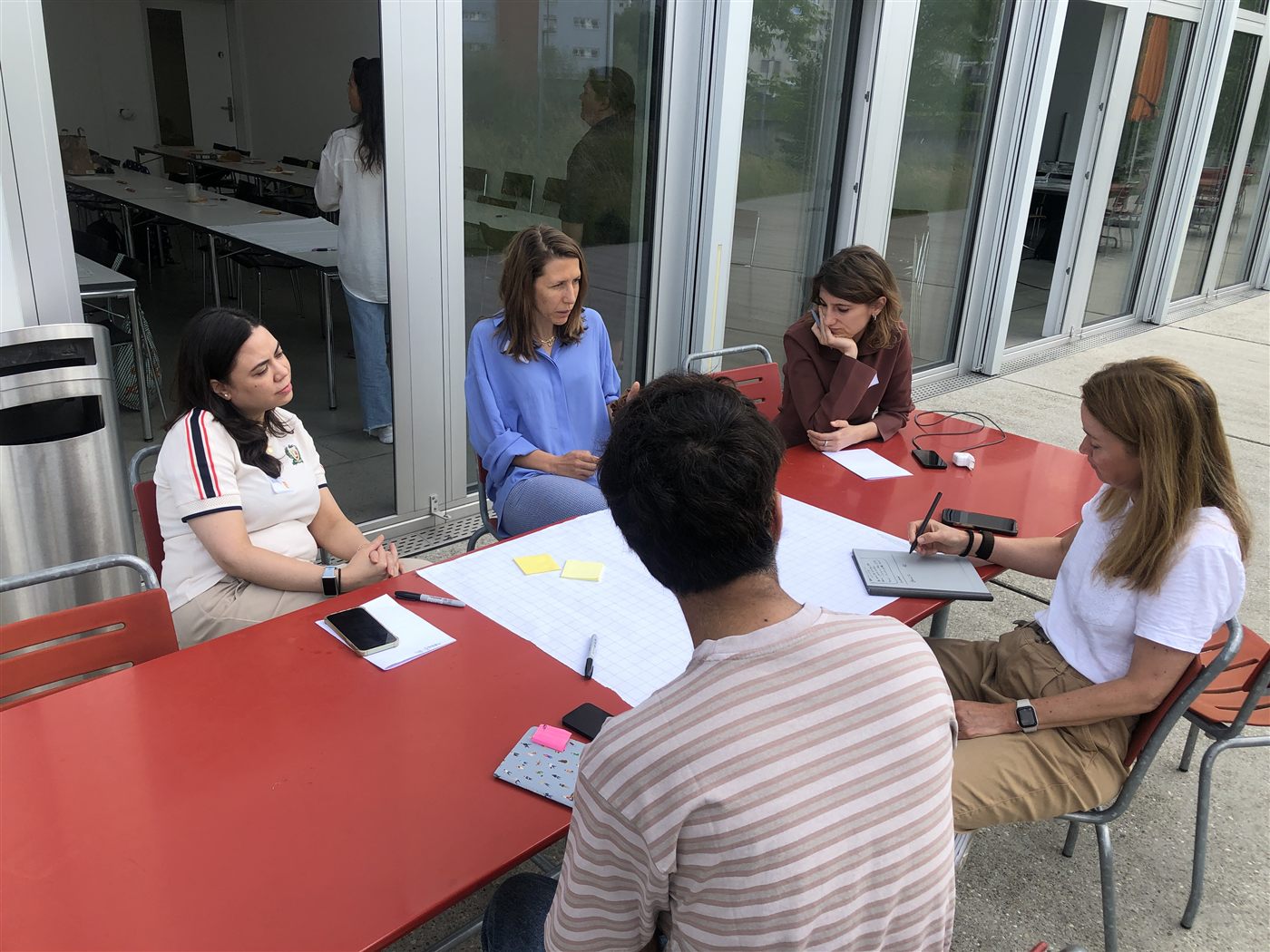
Good discussions amongst the participants of the workshop
Participants with different backgrounds and different realities
The workshop was part of World Service Design Day, organised by the Service Design Network Switzerland. What made the session particularly valuable was the diversity of perspectives in the room.
We had participants from a government undergoing transformation in Hungary. Swiss federal and cantonal organisations feeling uncomfortable with the debate around a potential population cap of 10 million people. Representatives from the City of Zurich. Participants from Italy with different administrative traditions and realities. And colleagues from the Dutch public sector.
Different countries. Different contexts. Different challenges. But also similarities.
Why is it not clear that we also need experts to design public services?
The level of expertise in the room was impressive. Participants understood public services in their broadest sense — from taxation and community building to quality of life, digital transformation, inclusion and sustainability.
One observation stayed with me throughout the day. A participant wrote:
„Why is it clear to everyone that a city needs experts for buildings — architects — but it is not clear that we also need experts to design our services?“
For those of us who work in design, it feels like an obvious question. Yet it touches the heart of why service design in government is still fighting for its seat at the table.
The questions that followed were equally sharp:
Can government truly segment its audiences in the way commercial organisations do? Is segmentation even appropriate when you are designing for everyone? Is co-creation a genuine goal in public services, or does it remain an aspiration that struggles to survive political reality? How do siloed departments collaborate effectively? And how do you measure success when outcomes may only become visible years later?
These questions cannot be answered in a single afternoon. But they shaped every conversation that followed — and they are exactly the questions a room full of committed professionals to service design should be asking.
Starting with a brainstorm: three fundamental dilemmas
To warm things up, I asked participants what comes to mind when they think about public services and service design. What emerged was not a list of tools or methods, but three fundamental dilemmas that sit at the heart of designing for government.
1: Public services are designed for everyone — and that makes them uniquely difficult to design for.
Public services must be universally accessible. That is both their greatest strength and their greatest design challenge.
In commercial service design, we identify target groups, develop personas and make deliberate choices about who we are designing for. In public services, that luxury largely disappears. Services must work for the elderly person with limited digital skills, the newcomer who speaks little German, the entrepreneur in a hurry and the vulnerable family navigating a crisis — often all at the same time.
The risk is that, in trying to serve everyone equally, we end up creating services that feel generic, impersonal and designed for nobody in particular.
2: Being a citizen is not the same as understanding citizens.
Public servants are themselves citizens — they pay taxes, use schools and travel on public transport — there is often an implicit belief that they already understand the user.
Most government professionals have higher education, digital confidence and institutional knowledge. Yet many people who depend most on well-designed public services do not match this profile. Without design research; interviews, observation and journey mapping, the gap between the designer’s world and the citizen’s reality remains invisible.
And invisible gaps often become design failures.
3: The problems are interesting, complex and wicked!
Service designers are trained to deal with complexity. Our approach is to break complex problems into smaller pieces and from a human perspective: a pain point, a moment in a journey, a specific interaction, a moment of truth.
In public services, that approach often collides with political reality.
Political issues are broad. Mandates are ambitious. Decision-makers are frequently more comfortable discussing vision than testing incremental improvements.
The challenge for service designers is learning how to respect political realities while continuing to make problems concrete, tangible and testable.
Inspiration from the Netherlands and Switzerland
I gave a short introduction to the differences between Dutch and Swiss public services — two systems I know well and two countries with very different structures, cultures and political systems.
The Netherlands is increasingly embedding human-centred design into governmental services. I am currently involved in the national Customer Journey Training Programme for the Dutch Ministry of the Interior.
Switzerland follows its own path, shaped by its federal structure, political culture and unique relationship between citizens and government.
Understanding these differences is essential — not to copy one another, but to understand which approaches and tools can successfully translate across contexts.
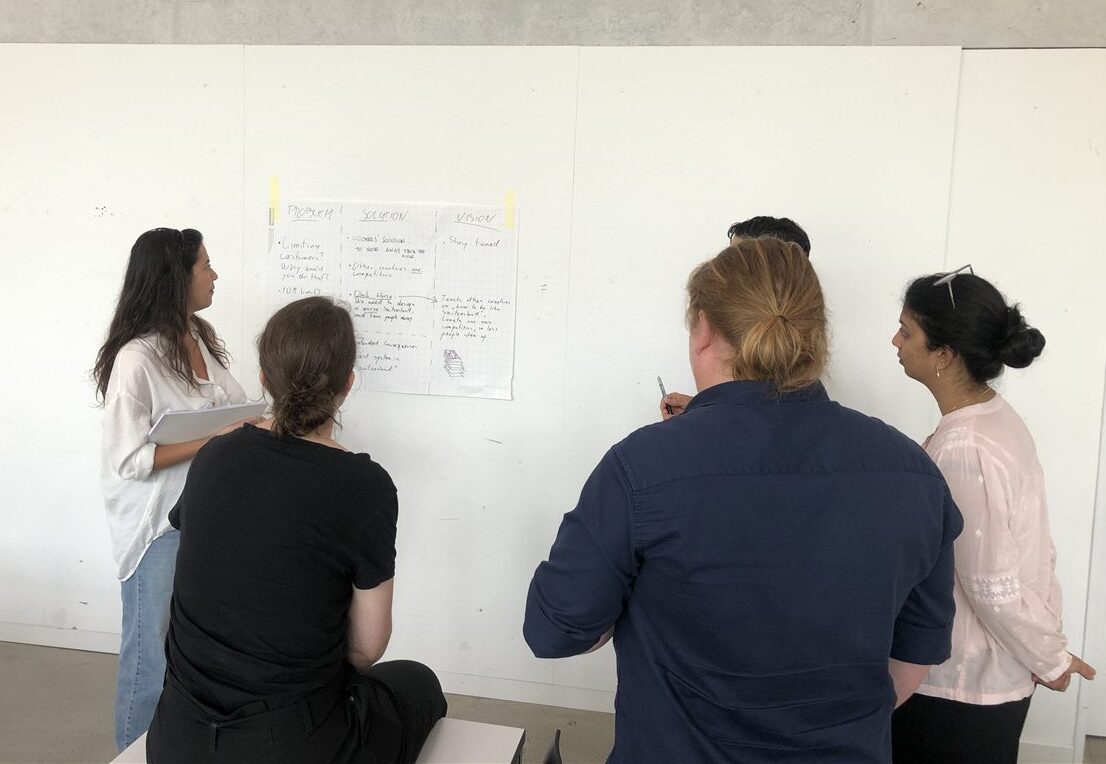
Picture of the group exercises; presenting a design challenge as part of a Newsitem (Tageschau) with a positive mindset.
Group exercises
Group 1: Designing for the 10 million cap on Switzerland
The first group tackled one of the most politically sensitive topics in Switzerland today: to cap the Swiss population at 10 million inhabitants.
The design challenge was simple:
If Swiss citizens vote yes, how do you design public services that implement such a decision in a way that is fair, humane and practical?
This is exactly the kind of brief that initially makes service designers uncomfortable. The political decision itself is not ours to make. Our task is to design the best possible experience around whatever democratic decision is taken.
The group generated several striking ideas, including one deliberately provocative concept: making Switzerland slightly less attractive to discourage immigration. The idea was not intended as a serious proposal, but to look at it from a different angle. To identify possible options to further explore.
Their alternative vision was more constructive: help other countries become more like Switzerland. Export successful models, strengthen neighbouring regions and create opportunities elsewhere.
Counterintuitive, perhaps. But also, thought-provoking.
Group 2: Swiss Gov Goes Crazy for Design
The second group explored a different question:
What would happen if the Swiss government truly embraced design?
Their vision was a dedicated government design agency, bringing together UX, Human-Centred Design, Service Design, Customer Experience and Research.
Their goal was clear: create faster, simpler and more human-centred public services.
The group proposed responsible AI grounded in Swiss values, more integrated systems, talent development programmes and stronger cross-department collaboration to reduce fragmentation.
What struck me most was the balance between ambition and practicality.
They were not imagining a perfect government.
They were sketching a credible first step.
The room was buzzing — and that was the point
Across both groups, the discussions revolved around the tensions that make public sector service design so fascinating: the gap between what is politically possible and what people actually need, the challenge of defining the user, and the difficulty of changing systems that were never designed to change.
Participants from Hungary brought experience from a government in transition. Colleagues from Italy and the Netherlands contributed with different perspectives. Swiss participants from federal organisations and the City of Zurich brought local knowledge and real-world constraints. What nobody in the room lacked was commitment.
A participant’s reflection
“I really liked your workshop – got inspired! Thank you.”
~ Workshop participant, Swiss Service Design Day 2026
My question to you
If you work in government — at any level and in any role — and you have never worked with a service designer, I encourage you to try it.
Not to get a prettier presentation.
Not to get a new website.
But to gain a different way of understanding the people you serve.
And if you are a service designer working in the commercial world and wondering whether government work might be for you: it is slower, more complex and constrained by politics.
But the impact is incomparable.
When you get it right, it works for everyone.
That, ultimately, is what this Service Design Day reminded me.
The room was full of people who understand that design is not decoration.
It is how we make life work better for the people who need it most.
Barbara van Duin is a customer experience and service design specialist working from the Netherlands for European countries, like Switzerland. Working at the intersection of public services, organisational change and human-centred design. She is a founding partner of in-Novation.
Want to discuss or explore further on what public service design could mean for you or your organisation?
Feel free to contact Barbara van Duin:
+31 (0)6 17028312
barbara.vanduin@in-novation.ch

Barbara van Duin
Certified Customer Experience Professional (CCXP)